What we’re exploring
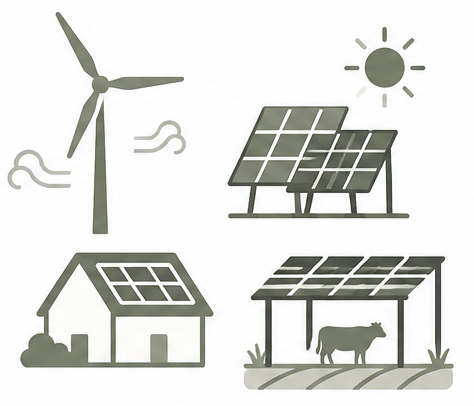
Charsfield Community Energy is looking at a mix of technologies, not a single large installation. The aim is a solution that’s the right scale for the village and works alongside how the land here is already used.
Technologies that may be feasible
- Ground-mounted solar Solar panels mounted on simple frames in suitable locations, generating electricity directly for local use.
- Roof mounted solar – panels on suitable roofs whether commercial, agricultural or domestic.
- Agri-voltaics Panels raised on taller frames above crops or grazing land, allowing farming to continue underneath. This is a relatively new approach in the UK that lets land do two jobs at once.
- Small-scale wind – this could continue the tradition of pride in the village windmill.
The land question
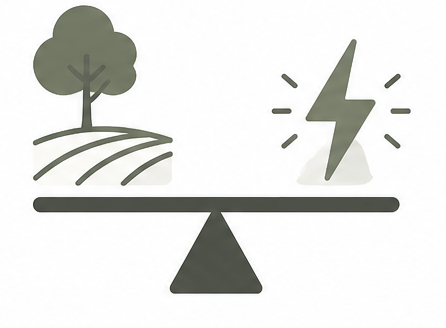
We know that “solar vs. food” is a live debate, and rightly so — good agricultural land matters. That’s part of why we’re not proposing a conventional solar farm. Agri-voltaic systems are specifically designed to let farming continue on the same land, and any ground-mounted solar will be sited to avoid taking land out of food production where possible. The feasibility study will set out exactly what’s realistic here.
The feasibility study

A Stage 1 Feasibility Study is currently underway to establish whether — and how — Charsfield could generate its own electricity.
Key facts
- Commissioned by: Charsfield Parish Council
- Funded by: A generous grant from the Community Energy Fund
- Carried out by: Locogen Consulting Ltd
- What it covers: current and future energy demand, technical feasibility, suitable sites, grid connection, indicative costs, ownership models
- Reporting: September/October 2026
What happens next

Once the study reports, and we have all the available information, the full report will be shared with the village before any decisions are made about next steps. The decision-making process will involve the whole community and will entail widespread community consultation through public meetings, canvasing for suggestions, response mechanisms, parish council vote and further community consultations. This is a vital part of a community energy project all available (non-confidential) information is shared openly and the decisions are made by the community, for the community. It is not a foregone conclusion that a suitable plan can be created for Charsfield. If it is simply not viable to generate worthwhile electricity supply for the community, the project stops there.